During its existence, between 1931-1988, the floating dock just off Aotea Quay was a prominent feature of Wellington Harbour, readily seen from the road or rail line at the Kaiwharawhara entrance to downtown Wellington.
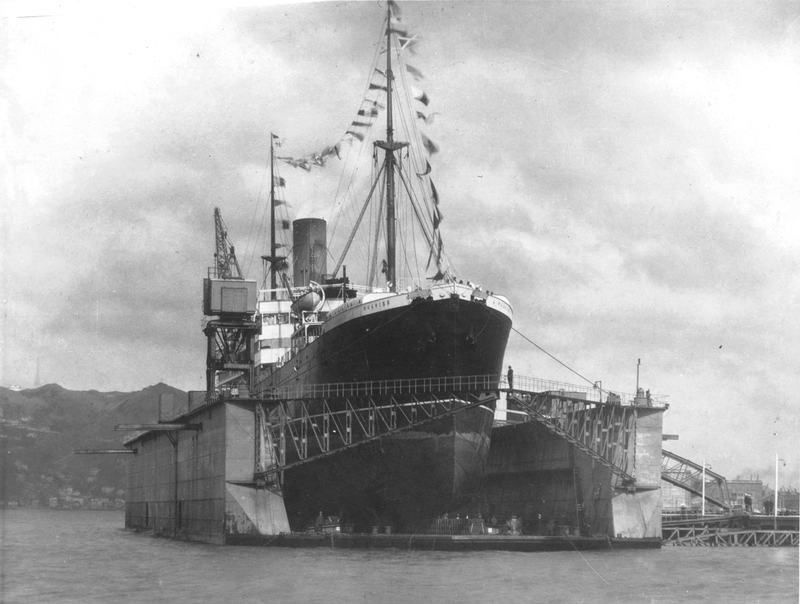
The Union Steamship Company vessel the S.S. Ruahine; the first ship to be loaded into the dry dock, 1931. Wellington City Libraries, ref: 50002-4-85, https://wellington.recollect.co.nz/nodes/view/213
Local marine maintenance facilities were a vital part of international and local shipping infrastructure. New Zealand’s main centres competed to provide facilities and attract business to their region. Auckland, Lyttelton and Dunedin built graving docks or slipways, while after a false start, the Wellington Harbour Board opted for a floating dock.
Agitation for a dry dock in Wellington started as early as 1868 with, at different times, locations of Evans Bay and Te Aro being touted. The latter obtained legislative blessing and after study of docks offshore by the Wellington Harbour Board engineer, later consultant, William Ferguson the site was dredged by the Board and a construction contact was let in 1907 for a graving dock. The contractor was relieved of the contract in 1910, stating the design was not capable of construction. The work was abandoned.
The Wellington Harbour Board (1880-1989) then opted for a floating dock, to be positioned just off Aotea Quay. The Harbour Board ordered the dock in 1930 and named it the Jubilee Dock in honour of the Board’s 50th year. The General Manager and chief engineer to the Board was James Marchbanks. He too had undertaken a trip to study docks. The designers were Clark and Standfield, London, who specialised in floating docks. It was built by Swan Hunter and Wigham Richardson of Wallsend, Tyne and Wear, England. The dock was towed to New Zealand via the Suez Canal. It was delivered in 1931 and began operating in April 1932.
The lifting bed was 533 feet long over the keel blocks and 87 feet wide (162m x 26m). Lowered it had 25 feet (7.6m) of water over the keel blocks. It could raise a vessel of 17,000 tons (15,400 tonnes). There was a travelling crane mounted to one side. It was all electrically powered from the shore.
The shore works to which it was moored were built adjacent to the Thorndon reclamation, consisting of a wharf and four dolphins for securing entering ships.
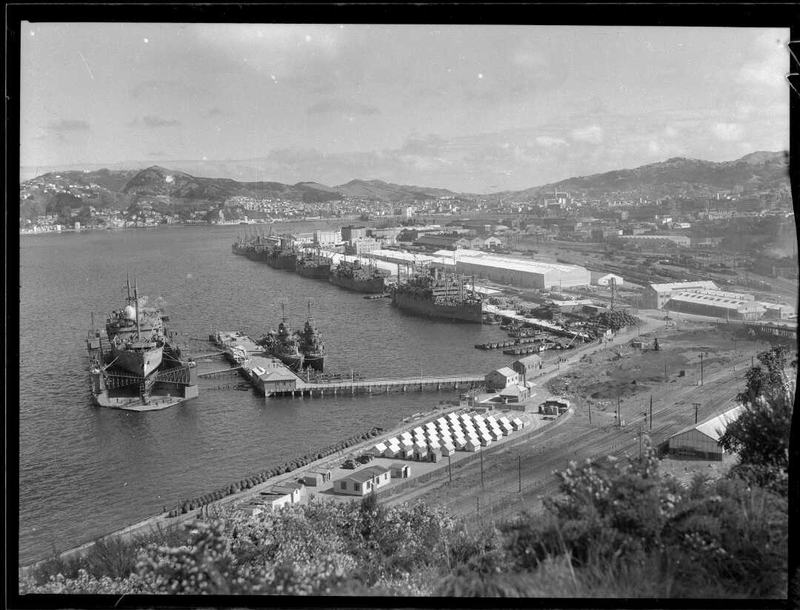
Floating Dock and Aotea Quay, Wellington. Photographs taken for the Wellington Harbour Board. Ref: 1/4-031273-F. Alexander Turnbull Library, Wellington, New Zealand. /records/22842511
The first trial lift was of New Zealand Steamship Company mixed passenger / freight ship S.S. Ruahine. The first commercial lift was of the Wellington Lyttleton Ferry T.S.S. Maori, operated by the Union Steam Ship Company.
The Harbour Board provided the lifting service but no other related maintenance or repair services. Ship owners had to arrange those separately. Later in its life the Jubilee name was dropped.
The dock was a key resource for allied navies during the second world war. In the course of time and with the advent of container ships the dock was less used by international shipping. A typical container ship of the 1980s was well beyond its capacity. Local ships could still be managed but the demand had lessened with the decline in coastal shipping.
The dock was sold in early 1988, initially with the expectation it would be refurbished and continue service in Wellington, but this proved futile and it was sold on. It departed under tow in late December 1988 , only to break in two in a force 9 gale in the Tasman Sea, the parts sinking separately six days apart. The first part was reported as sinking at 37ºS 169ºE, 490km west of Manukau Heads and the second part, where it was towed on to, 190km further west.
The wharf part of the dock survives, now part of the harbour’s RFT3 ferry terminal.
More information
New Zealand Archaeological Association
The site is in the New Zealand Archaeological Association Site Records as site R27/909. See ARCHSITE
Further reading
P J Leahy, "Jubilee Floating Dock", New Zealand Marine News, vol 39 no 4 (1989): 198-200.
Gavin McLean, Shipbuilding – The iron and steel era, Te Ara – the Encyclopedia of New Zealand, (accessed 9 April 2026) https://teara.govt.nz/en/photograph/5501/wellingtons-jubilee-dock
“Te Aro Dock. The contract abandoned”, Evening Post, 21 September 1910, p3.
“A dry dock wanted", Wellington Independent, 6 June 1868, p1.
“Wgtn bids farewell to floating dock”, Press, 28 December 1988, p3.
Wellington Harbour Board, "Wellington Harbour Board floating dock," 1932, https://natlib.govt.nz/records/22737043
Related Engineering Heritage Record entries
Page last updated 09 April 2026