Te Rā is the only surviving Māori sail. It is over 200 years old.
Polynesian ancestral voyaging to the eastern Pacific and to its island extremities was a feat of navigation underpinned by sophisticated technology. It is impossible to conceive the extent of the voyaging other than with the assistance of the wind, using sails – rā – in te reo.
When written records began to be created about Polynesian craft, sails were commonly described, but few physical examples have survived. Those depicted for Aotearoa New Zealand are of spritsail form, attached to two spars. This sail is of that form. It is rigged with a leading moveable spar, stayed to the waka and the trailing spar sheeted. A rigidly fixed mast was not used with this form of rig.
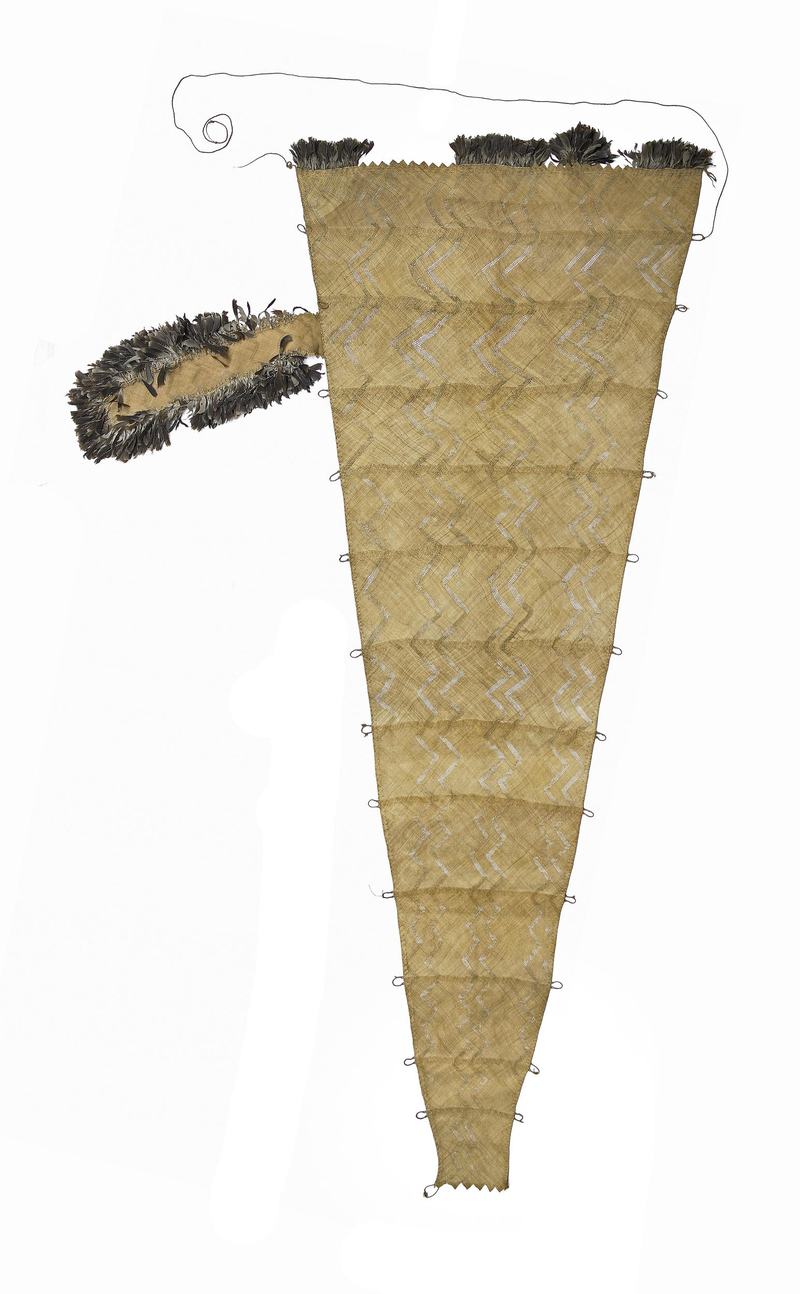
Te Rā © The Trustees of the British Museum. Shared under a Creative Commons Attribution-NonCommercial-ShareAlike 4.0 International (CC BY-NC-SA 4.0) licence.
That sail-driven voyaging is ancient is demonstrated by the wide distribution of sail driven craft, but particularly by words which can be reconstructed as part of the ancestral languages. The ancestral word for sail has been reconstructed as *layaR for the original of the Pacific-wide language family, proto-Austronesian. (The ‘*’ signifies a reconstruction). The cognate word rā in Māori is one of many descendants. Many other terms related to waka, sailing and voyaging have similar ancestral reconstructions. Many continued in Māori.
Te Rā is 4.4 m tall. The British Museum description is:
Plaited in check from strips of flax leaf, in thirteen panels joined together with mat joins, with zigzag bands of hexagonal openwork three-directional plaiting; along top edge and around ‘tail’ fringes of dark coloured feathers. Loops made of four two-ply, soft, flax-fibre strings wrapped with fine rolled cords; some loops still have kaka feathers attached; two have small remnants of dog hair.
The sail has little sign of use and is in excellent condition for its age.
It is an intricately made item, certainly not a utilitarian. Multiple materials are used suggesting selection of each for their optimal application. The patterning in the central part of the sail is carefully arranged to be framed in the sail shape. Some parts such as the size of the leeward tell-tale or pennant, the patterning in the weaving and the extent of the feathers go beyond functional need and strongly suggest it is a prestige item. It was made by experts. Bias in the weaving has been suggested as a function of needing to hold shape. The openwork in the sail has been suggested as a functional element assisting sail resilience. The locations of the loops for the spars are matched to the joint detail of the weaving.
The sail has been researched by a team led by Donna Campbell, Ranui Ngarimu, Catherine Smith and Hokimate Harwood, funded by a 2017 Marsden grant, entitled Whakaarahia anō te rā kaihau! – Raise up again the billowing sail! An associated weavers group entitled Te Rā Ringa Raupā, led by Maureen Lander, have produced a scale and a full-sized replica, thereby uncovering information on the techniques used. The scale replica has been tested on a waka in the Hokianga Harbour.
The research and replica teams are all women. In modern Māori practice weaving is a craft of women. While it cannot be beyond doubt, it is reasonable that Te Rā is a traditional product of women.
It is not known where the sail was made or collected or the nature of the transaction in its collection. Its route to the British Museum collection is also unknown. It is an unusually large piece for an item collected by an early European visitor – perhaps one who recognised its special character.
In the modern revival of traditional voyaging some waka have been sailed successfully with traditional sails.
Woven pieces, conceivably parts of a sail, are part of the items recovered from the 2024 archaeological discovery of canoe parts on Rēkohu-Wharekauri-Chatham Island. This may yet expand knowledge of the form of Māori / Moriori sails.
Other scholarly studies of sails
There is diversity of opinion among scholars over the double canoe vessel forms and sailing rigs used by early Polynesian voyagers.
Atholl Anderson in a review of the history of Pacific sailing craft concludes that the spritsail rigged like this is the ancestral form for Polynesian voyaging and in New Zealand, “… appears to have been the original and only sailing rig until the nineteenth century.”
Geoffrey Irwin and his co-researchers (2023) consider a wider variety of sailing rigs as potentially early in Polynesia. They report on wind tunnel and towing tank tests on a variety of hull and sail forms. The tests of pandanus made sails were undertaken at the University of Auckland Yacht Research Unit, in a twisted flow wind tunnel. The tank and wind test results were combined to boat performance figures using a numerical tool.
In a further paper Irwin and co-researchers (2025) look directly at Te Rā alongside two other surviving Polynesian sails from elsewhere. They consider the form of Te Rā was Māori adaptation, suited to local use in large-bodied single canoes, which were preferentially paddled upwind, rather than sailed.
Māori commonly trace their whakapapa back to the leaders and crews of named ancestral voyaging canoes. Te Rā is highly evocative for Māori. All New Zealanders, tracing their ancestry through journeys here can relate to it and those involved in the sport of sailing.
The knowledge, drawn from long experience, embedded in this item make it worthy of recognition as an item of engineering heritage.
Ki uta tārei ai, ki tai rewa ai
Prepared onshore to sail at sea
- Ngāti Maniapoto proverb.
More information
Location
British Museum. Collection identifier: Oc,NZ.147
Access / Viewing
The sail is on long term loan to New Zealand, 2023-2026 and was exhibited in Christchurch and Auckland. Its future display intentions are unknown.
Further reading
"sail (ra); canoe", The British Museum, accessed 16 March 2026.
Anderson, A. (2024) “The Origins of Prehistoric Sailing Technologies in the Pacific Ocean.” In The Oxford Handbook of Island and Coastal Archaeology.
Irwin, G., Flay, R.G.J., Dudley, L. and Johns, D. (2023) “The sailing performance of ancient Polynesian canoes and the early settlement of East Polynesia.” Archaeology in Oceania, 58: 74-90.
Irwin, G., Sheppard, P. and Flay, R. (2025) “Three late 18th century CE East Polynesian sails in the British Museum collected from New Zealand, Tahiti and Hawaii (or the Marquesas) reveal regional adaptations in sailing technology.” Journal of Pacific Archaeology, 15(1), Article 6.
Page last updated 04 June 2026